
Chunee
The Elephant Murdered in Regency London

On London’s famous street, The Strand, there once stood the Exeter Exchange. It was a menagerie opened to the paying public who gawped at lions, tigers, monkeys, and other wild-caught animals imprisoned in iron cages in small rooms.
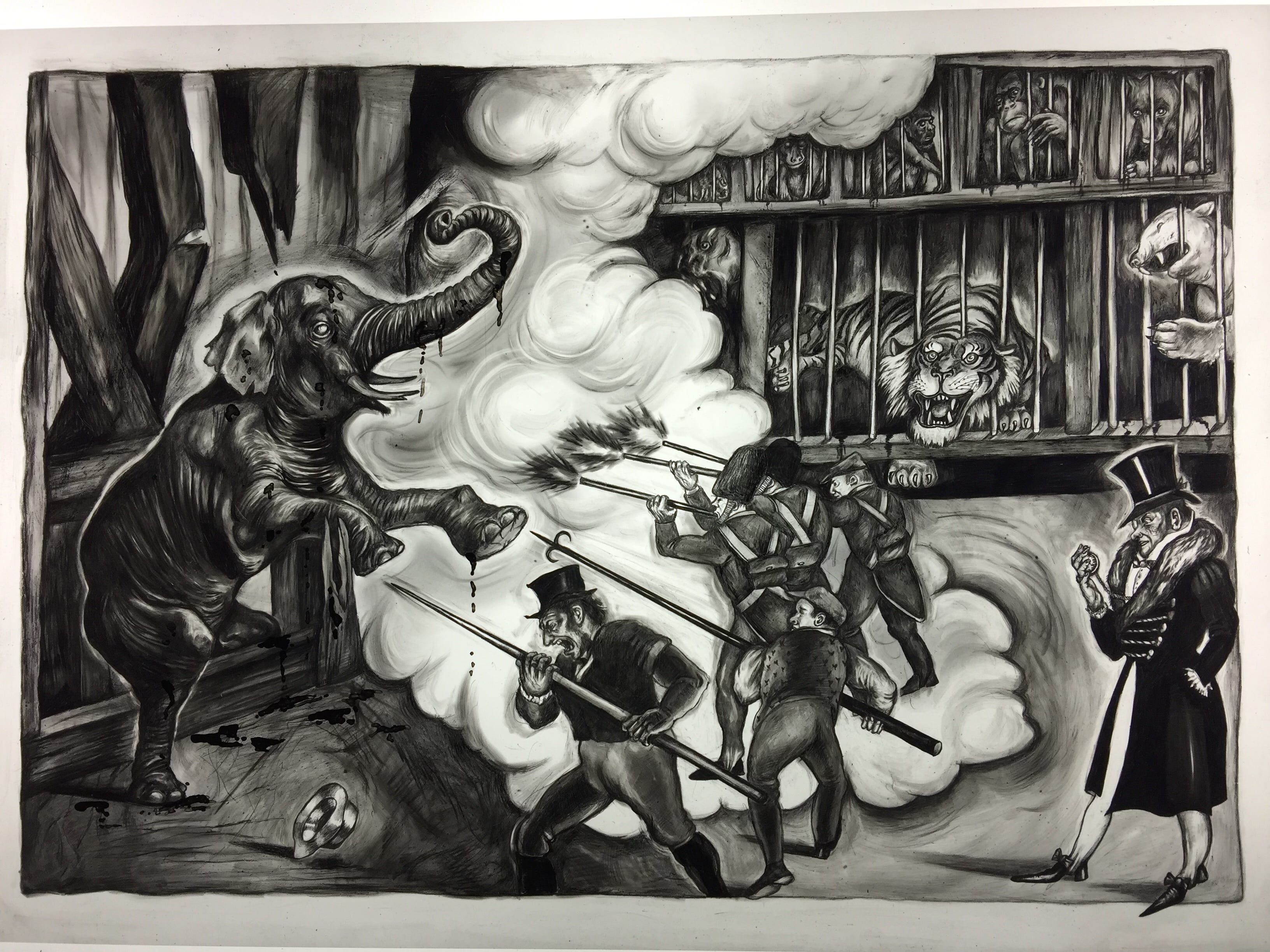
Among them was Chunee (aka Chuny or Chuneelah), a male Asian elephant born somewhere in Southeast Asia and wild-caught as a baby. He was exported from Bengal, India, to London in 1809 or 1810 by the East India Company. He appeared in various theatrical productions at the Covent Garden Theatre in 1811. Chunee was taken to the Exeter Exchange, and for the rest of his life, he lived behind bars on public display, becoming a much-celebrated London attraction.
Lord Byron (1788-1824) wrote in his journal about a visit to the Exeter Exchange in 1813.
The elephant took and gave me my money again—took off my hat—opened a door—trunked a whip—and behaved so well, that I wish he was my butler.
In Jane Austen’s (1775-1817) Sense and Sensibility, John Dashwood blamed a visit to the Exeter Exchange with his son, Harry, for not calling promptly on his stepfamily of Elinor Dashwood, her mother and sisters.
I wished very much to call upon you yesterday … but it was impossible, for we were obliged to take Harry to see the wild beasts at Exeter Exchange.
Chunee grew to five tons at the Exeter Exchange. He became increasingly rebellious, imprisoned in a small cage, and experienced the natural condition of musth when testosterone fuels their need for freedom and search for females to mate with. He committed no crimes other than self-defence when he sought to escape from his imprisonment. On his usual Sunday walk along the Strand, Chunee ran amok, killing one of his keepers. Edward Cross, who bought the Exeter Exchange in 1817, decided the wild elephant had to be killed.
On Wednesday, 1 March 1826, Chunee died from wounds after a sword strapped to the end of a rifle was plunged into his neck, and a firing squad of soldiers summoned from Somerset House shot at close range 152 bullets into his body. Chunee stood trapped in a wooden cage, which, according to The Times, was
no greater proportion to his bulk than a coffin does to a corpse.
Hundreds of people paid a shilling to view the dissection of Chunee’s corpse. Reactions to his murder prompted protests, aggrieved letters to the editor were published in newspapers, numerous poems were written, and a successful play was written. His death was widely publicised in pamphlets and illustrations printed in popular newspapers. His hide was sold for £50, the skeleton for £100, which went on display with the bullet holes in his skull visible. The skeleton remained on display in the Royal College of Surgeons’ Museum until 11 May 1941, when it, and the museum, were destroyed by a direct hit from a high-explosive bomb.
The British East India Company: Militarized Capitalism, Colonialism, and Interspecies Oppression
Another horror story! Poor Chunee!