

Who are animal advocates?
In his book Empty Cages, philosopher Tom Regan describes three basic personality types: Davincians, Damascans, and Muddlers. Davincians feel intuitively for animals and are ‘born with an ability to enter into the mystery of the interior lives of animals.’ Damascans ‘undergo a dramatic and often instantaneous perception change in their attitude toward animals.’ Muddlers ‘grow into animal consciousness step by step, little by little.’ At different times, we may be a combination of two or all three of these personae.
Psychologist Ken Shapiro adopts a different taxonomy. Animal advocates he suggests are ‘caring sleuths’, who ‘persist in assertively and, when necessary, aggressively expose animal suffering’. Caring sleuths see animal cruelty and exploitation when many others don’t. A leather coat is not a glamorous accessory but the skin of a dead cow. He places considerable emphasis on the quality and depth of caring experienced by animal advocates. ‘It means being attentive to them [animals] in a watchful and concerned way’, he writes.
More than just a curiosity or interest, it is a positive inclining or leaning toward them, a sympathy for them and their needs. A caring attitude is one of continuous sensitivity and responsiveness, not a transitory awareness or a momentary concern.
For many people, the moral shock of animal exploitation strikes at the heart of how they see themselves and their world. It’s a personally transformative moment that hastens uncomfortable and hitherto hidden realisations. A moral shock may also be prompted by the discovery of the connection between a beloved companion animal and other animals.
As Shapiro notes of the caring sleuth: first, we care; then, we see; and then we seek out animal suffering. The ‘provenance of suffering’ must be revealed. We shine a spotlight, refusing to conspire with society, hiding it from view. We want others to see what we now see. To experience similarly transformative moments. We believe society will change if enough people undergo enough moral shocks. That urgency is why the animal rights movement and its repertoire of protests (e.g., demonstrations, boycotts, civil disobedience, and publicity stunts) is so focused on fomenting public outrage. The emphasis is on the individual to think, care, and act. Go vegan! Go cruelty-free! Don’t buy fur! Boycott zoos! If I can change, you can, too!
Chicken Slaughterhouse
When I worked in the chicken slaughterhouse in the 1970s, I saw institutionalised animal exploitation for the first time. In later years, I discovered even more ways in which animals are exploited by a complex of industries. The more I learnt, the more I needed to seek out animal cruelty and exploitation. As I discovered its pervasiveness, I had to learn how to cope with that knowledge. I had to reconcile myself with the truth that animals are being tortured and killed every second of every minute of every hour of every day, year in and year out, frequently for no other reason than momentary, gustatory pleasure.
The result for many of us who take on that knowledge is a strange, bifurcated existence. I live in my vegan world, in which I see what I think is food; and I live in a meat-eating universe. Not surprisingly, perhaps, we caring sleuths find ourselves continuously torn by such a dichotomy. We do what we can personally to match our values with our life choices. But more than that, we feel obliged to stay in the moment of animal suffering—notwithstanding its emotional and psychological toll. To leave is impossible. It would be to abandon the animals. This is something we cannot do. If we’re not there, who will be? We must care because no one else does. We must act because no one else will. We must remain true despite the ridicule, the dismissals, and the condescension. We must be permanently on call to respond to the demands of our conscience. These are the first truths of animal advocacy: that what society considers usual is obscene; that the normative ‘truth’ about what is ethical to do to animals is in fact an ‘untruth’.
The animal industrial complex needs power and control to maintain its existence. Both are based on a belief that the subject to be controlled possesses no rights of any kind. Animals are considered property under the law, which ensures that animals are always open to the abuse of those who claim ownership of them. The legal standing (or lack thereof) of animals and their economic status as disposable commodities legitimise the multiple institutions and manners in and by which we exploit animals for our use.
We’ve constructed a system for treating animals that depends on not being able to see inside the factory farms, slaughterhouses or research laboratories. If we did, perhaps we might not be as willing to eat fried chicken or take medication without first considering the consequences of our actions and their impact on people, animals, and the environment. The animal industrial complex is a gruesome gulag, involved in the imprisonment and extinction of beings far exceeding the worst atrocities we’ve committed on ourselves. To escape from the truth of what we do, we tell untruths to ourselves and our children about the animals whose lives we abuse and take: that animals wouldn’t exist or they’d overrun us if we didn’t eat them and that they’re humanely slaughtered.
How ready we are to accept these and many other lies about how we couldn’t survive unless we exploited animals! Most of us would be appalled at being considered a party to murder on such a mass scale when we’ve never directly harmed or killed an animal in our lives. Indeed, it’s beyond our comprehension that we’d ever do so. But this is what we do when we eat meat, eggs, and dairy, use cosmetics and household cleaning products or wear leather or fur.
Truth Opens
The opening to the truth that accompanies the refusal to accept the lies about what we’ve been told about animals and our proper relation to them constitutes in and of itself a moral shock, as hitherto unimaginable ways by which animals are treated and exploited reveal themselves to us. The veil of secrecy is lifted. We discover that animal cruelty is present throughout our world, in the lives we live, the products we buy, and where we work and play.
The second set of truths that animal advocates are forced to confront is that no one ever promised that caring deeply about animals would be easy. No one could have reasonably believed that society could transform itself as quickly as we may have changed. To advocate for the rights of animals not to be eaten by human beings is to alter a mindset reinforced over thousands of years and countless generations. Eating meat is a comfortable, reassuring tradition valourised institutionally, theologically, politically, and economically.
Why do non-vegans think they have the right to treat animal advocates as moral and psychological enemas for their uneasy and defensive feelings about the dead animals on their plates? Why do non-vegans assume vegans have to be patient and listen to them as they prevaricate or struggle with giving up cruel and inessential animal products?
We are not obliged to be infinitely forgiving and affirming.
The third truth that animal advocates need to face is that, in my experience, not everyone reacts to moral shocks as they could or, we might hope, should. Some never respond. They don’t care about nonhuman animals, and they never will. Instead, they make a virtue of their insensitivity.
Misanthropic Bunker
Confronted with a world of unremitting violence towards other animals, where others fail either to see what you witness everywhere or don’t act on their conscience, it’s easy for advocates to seek refuge in what I call the ‘Misanthropic Bunker’. We’ve all done it, no matter how positive or can-do our attitude about convincing others to become vegan or creating social change may be. And here is another truth about animal advocacy: that the retreat may be a necessary way of coping. I also do this when I’m fed up and disappointed with the animal rights movement. We’ll never achieve animal rights, I tell myself. Speciesism will never end. Animal rights will never be accomplished. It won’t happen in my lifetime.

I try not to lurk too long inside the Misanthropic Bunker. I know that for all the reassurance and sanctuary it provides as a place where it’s possible to blow off steam and rail at how much better the planet would be without humans (unless those humans were like me!), it’s also an excuse to wallow in self-righteous indignation. It’s not only strategically vital to direct our animosities in a more positive and effective direction, but it’s also psychologically essential to avoid being consumed by hatred and intolerance.
Here is how I understand Truth.
Imagine a mighty oak tree standing proudly in a beautiful green field. From afar, the tree is an organic whole. Standing underneath, we can look into its canopy and see from its central trunk larger branches spreading outward and smaller branches disappearing into the foliage. As we observe more closely, we perceive the uniqueness of each bough and every narrower limb. For all its components, nothing would be possible without the trunk. The branches couldn’t grow if there was no trunk, for the branches ultimately all stem from that main trunk, and despite their diversity, they share its characteristics. They are all equally interdependent.
This is how I envision universal truth—Truth with a capital ‘T’. The tree in its totality is the universe; the trunk is universal truth; the large branches represent the world’s religions and the smaller limbs are their various offshoots and sects. Other branches symbolise different traditions in philosophy, and still others the different means (e.g., political, economic, and cultural) by which we try to make sense of the world.
We are the birds who live in the oak tree. Some of us stay on a main branch to build a nest to raise our young. Others of us range from offshoot to offshoot, exploring smaller limbs for a while before returning to the main branch. As we travel along boughs away from the trunk, we leave Truth to enter the localised truth of the world’s various belief systems that offer a different and incomplete framing of Truth. Consequently, it’s a partial version of Truth. This analogy helps to explain why the origins of the world’s religions are so closely identified with specific regions of the globe, as well as the similarities and differences among them.
Just as it’s hard from our perspective as tiny birds on the enormous oak to comprehend or experience the totality of the entire tree, so we tend to believe our boughs (our systems and sub-systems of beliefs and ideologies) are the entire Truth. The fragmented aspects of universal truth and the different ways in which each of these belief systems requires us to behave generate conflict among different groups. This reality is counterintuitive and harmful and conflicts with what it means to be spiritual and to act compassionately, honestly, and peacefully.
Universal Truth
Fortunately, we can nurture our understanding and broaden our vision to embrace universal truth by expanding our insight and replacing harmful social and religious prejudices with a compassionate, holistic outlook that includes everyone—even animals. We can also dismiss political and philosophical ideologies that similarly reject the inclusion of animals in the moral community.
So, how might we define Truth in the context of the exploitation of animals and our response to it? Since I know from my own experience that humans can think, suffer, feel pain, and experience emotions, I logically conclude that animals also must be equally capable, as there’s fundamentally no difference psychologically, physiologically, and behaviourally between us. I reject the proposition that human wellbeing always necessitates the subjugation of animals, or that they exist on separate moral planes. In fact, I believe they’re inextricably interwoven.
More specifically, the exercise of truth means recognising our complicity in the animal industrial complex and the need to uncover the lies of those—including ourselves—who benefit from its horrors. How deeply embedded we are in its obscenities will reveal itself to us as we dig deeper and deeper into our use of animal products. But such an investigation is necessary if we’re to break through the distortions to reach a more honest and nonviolent relationship with other beings.
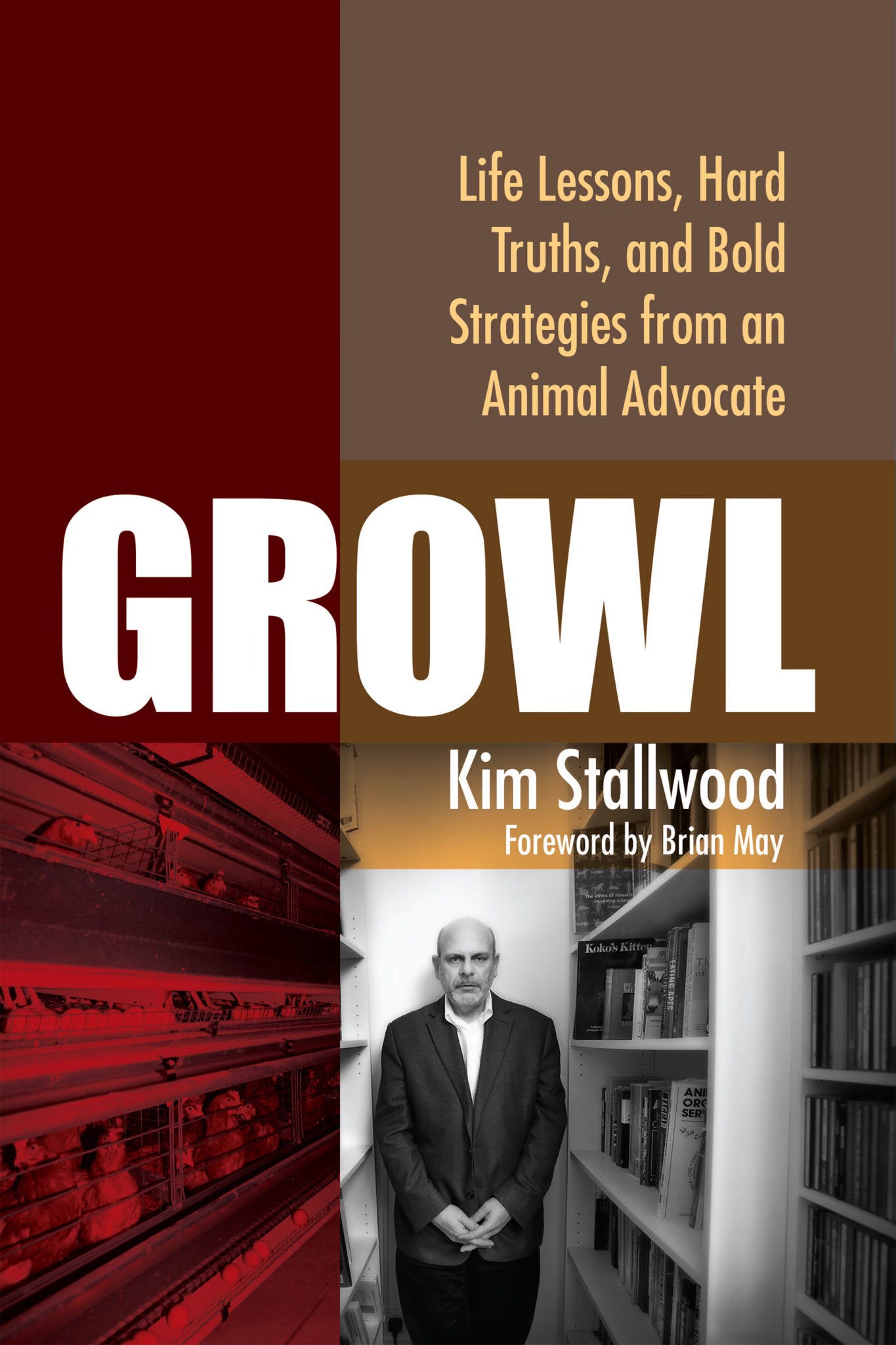
Adapted from Growl: Life Lessons, Hard Truths, and Bold Strategies from an Animal Advocate, with a Foreword by Brian May, and published by Lantern Publishing and Media in 2014. The Four Key Values in Animal Rights are Truth, Compassion, Nonviolence, and Justice. This is the first in a four-part series.
References
Regan, Tom. 2004. Empty Cages. Rowman & Littlefield.
Shapiro, Ken. 1994. The Caring Sleuth in Josephine Donovan and Carol J. Adams, eds. 2007. The Feminist Care Tradition. Columbia University Press.