

Institutionalised Violence
Day in and day out, farmers, scientists, entertainers, breeders, and others rape, torture, imprison, capture, kill, and violate animals on our behalf, and we continue about our business. And none of it is considered ‘violence’ because it’s been institutionalised as the structure by which the powerful and dominant in a culture corral the powerless and oppressed. Institutionalised violence was normalised in slavery and apartheid South Africa, and it remains so in the animal industrial complex.
Even though the bioindustrial-agribusiness systems are overt in that they don’t deny they exist, they’re covert in that they employ language and terms to deflect attention from their processes and regularise what is profoundly abnormal. They take advantage of people’s ignorance and their preference to remain so. As Ken Shapiro explains, a
combination of institutional arrangements, linguistic sleights of hand, and defensive operations ensure that animal exploitation persists in its invisibility.
This is how victims of violence at the hands of the oppressors become fortunate beings looked after by their natural superiors who know what’s best for them. As we’ve seen, the products of that exploitation are renamed and their origins hidden in euphemisms and a language that compartmentalises and deconstructs the individual until they’re fragmented body parts. Ubiquitous and yet hidden, these institutions are only visible to those who experience a personally transformative moment and become capable of seeing what is hitherto hidden or invisible. From then on, these systems are unavoidable.
It is no surprise that those who speak out within a society that has heavily invested in institutionalised violence are ridiculed, alienated, and even indicted for doing so. These activists, too, are subject to the same occluding and misleading language that defines institutionalised violence. They’re violent radicals, misguided subversives, or revolutionary zealots who want to overturn the ‘natural’ order of things in favour of an ‘unnatural’ social structure. Those of us who’ve seen through the lies of the animal industrial complex live in a strange parallel world. We find it baffling that those who claim to love animals wouldn’t see what we do.
Yet we were once blinded by the inverted rhetoric of the animal industrial complex. As the novelist and essayist Brigid Brophy wrote in her article ‘Unlived Life—A Manifesto against Factory Farming’
Whenever people say “we mustn’t be sentimental,” you can take it they are about to do something cruel. And if they add, “we must be realistic,” they mean they are going to make money out of it. [Cited in Wynne-Tyson]
Masculinity
One key aspect of the commitment to nonviolence needs to be mentioned: the role of masculinity.
I hope I’ve illustrated that being a vegan doesn’t automatically make you a ‘good person’, since you can adopt the regimen for any number of reasons (such as a bizarre desire for bodily purity, or as a cover for an eating disorder or to make yourself feel superior) that have nothing to do with living with more compassion or adopting the four key values. In a trope as well-worn as it is inaccurate, many meat-eaters trot out the observation that Adolf Hitler was a vegetarian as if somehow that comment was a thoughtful analysis of why someone may be committed to the health of the animals, the planet, and themselves. (See Berry)
Another frequent and tenacious meme—it would be giving it too much credibility to call it a line of thinking—is that not eating meat is somehow a sign of femininity, passivity, and weakness and that, conversely, eating animal flesh is a symbol of masculinity and strength. In her writings, Carol J. Adams has explored this sexualisation of eating meat and the parallel animalising of the female body and its products in pornography and advertising. With other feminist writers, she’s also looked at male violence against women and animals, particularly within the context of threatened or actual violence towards children and companion animals to control or terrorise the spouse.
Of course, women also eat meat, and some women harm their significant others (both male and female). However, most violence is committed by men, as is evidenced by newspaper reports and studies of various sorts. Whether it’s against human beings or companion animals in the home, hunting wild animals, or killing bulls in a ring, etc. For Adams and others, these acts of violence are functions of a patriarchal society where the male is defined by his lack of empathy with or concern for other animals, particularly domesticated ones.
‘Males, in our patriarchal society,’ writes the veterinarian Michael W. Fox, ‘may well show more cruelty toward animals, or justify the same, because they close off empathy more than females when faced with others’ helplessness and suffering’. He continues:
Self-serving religious and political ideologies also impair the ability to empathize, notably such ideologies as: man’s God-given dominion (over women, animals and nature).
At the beginning of his book Brutal: Manhood and the Exploitation of Animals, Brian Luke asks the reader to
[p]icture hunting, trapping, vivisection, slaughter, and animal sacrifice. Imagine them in concrete detail, even attaching faces and names to those who are killing animals. Now picture a demonstration against one of these institutions, again putting names and faces on the protesters. What do you see?’ His response? ‘Most likely you saw men killing and women protesting.
Like me, Luke is interested in ‘not so much why women oppose animal exploitation as why men support it’. As far as I’m concerned, compassion is not an attribute that’s gender-based. It’s something innate within us—nurtured by the education we receive, the values instilled in us by our family and society, and the choices we make in our lives. So why are members of my gender so apparently in love with violence?
One reason is surely because we’re used to being in control and holding power. The corollary of this is that if that control and power are threatened, those who used to be in charge lash out at those weaker than them. As a gay man, I’m aware of how I may be perceived by heterosexists as somehow feminised and, therefore, less powerful; as a man, I’m all too aware of my expectations of being the boss, of naturally commanding attention and respect, simply because my gender has for centuries been used to occupying the position at the metaphorical and actual head of the table.
In my judgement, if veganism and nonviolence are to mean anything beyond mere dietary preference and a noble and unachievable ideal, then they must grapple with our—by which I mean male as well as human—tendencies to wish to impose ourselves on others and manipulate them to do our bidding. We must be open to the possibility that we don’t have all the answers, that humility and attention and inspiring others through our behaviour are as valid expressions of leadership as posturing, causing the most noise, or making snap judgments under the guise of decisiveness.
How and Why
Mohandas Gandhi asked us to treat the ‘how’ (means or strategies) and the ‘why’ (ends or objectives) as equally significant. He wanted everyone to understand that they were personally empowered with moral agency to deliver self-rule for India. ‘Courage, endurance, fearlessness, and above all self-sacrifice “are the qualities required of our leaders’, Gandhi said (Bondurant). Note how all these virtues lead not to megalomania but to a kind of servant-leadership—a way of giving people the courage and force of will to move forward together in solidarity towards a shared goal. If everyone is both a follower and a leader, then no movement can be divided: each part reinforces the whole.
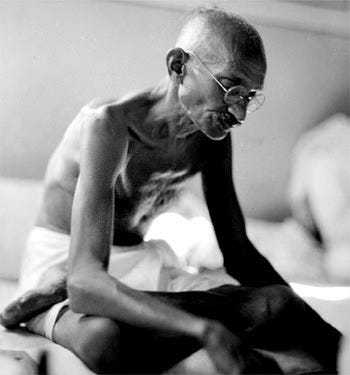
In fact, any commitment to veganism and nonviolence must be grounded in complete humility, simply because ahimsa is, itself, impossible.
Man cannot for a moment live without consciously or unconsciously committing outward himsa’, Gandhi said. ‘The very facts of his living—eating, drinking and moving about—necessarily involve some destruction of life, be it ever so minute’ (Borman).
Thus, to be a genuine vegan is to recognise the fact that one can never be vegan; to commit to nonviolence is to recognise how steeped in anger, disappointment, frustration, and simple pique we are as human beings—and to continue to pursue nonviolence nonetheless. I like taking Gandhi’s paradoxical reconciliation of the pragmatic realisation that being a vegan in a meat-eating world is an impossible task with the idealism of creating a world founded on compassion, truth, nonviolence, and justice.
It’s a sign of the ongoing development of the animal rights movement that we can no longer justify any action—no matter how ill-conceived, unstrategic, or self-defeating it might be—because it’s ‘for the animals’. Through our efforts to educate people and raise their awareness about the animal industrial complex, through our work to influence legislators and the passing of popular referenda around the world, and through an ever-increasing array of plant-based products that allow people to move to a diet that is increasingly being recognised as one that is best for the environment, the animals, and our health, the animal advocacy movement as a whole no longer needs to be defensive or feel that it has to fight its corner to be heard.
Witness and Document
Our task now is to maintain and enhance our credibility as reliable witnesses and documenters of the awful conditions for animals in circuses, zoos, factory farms, research laboratories, and wherever else they’re used. By making visible what’s invisible, by focusing relentlessly on the conditions for animals and not our own self-aggrandisement or self-righteous indignation, and by being professional in our communications, strategic knowhow, and presentation to the public, we’ll be more likely to pass laws that implement and enforce effective regulations protecting animals from harm and banning behaviours that hurt them. Further, if the movement successfully and honestly frames animal rights as part of a progressive agenda of social justice and not as a competition among human interests, I believe that our chances for success will be that much greater.
Armed with truth, fortified with compassion, and committed to nonviolence, we can leave the Misanthropic Bunker and show people, proudly and without embarrassment, that they too share the Magical Connection, one that their everyday actions and society’s institutionalised contempt for animals hide from them to their detriment. We can illustrate, without exaggeration or fudging the facts, the truth that the violence we inflict on animals shares the same root cause as the devastation we cause to the environment and the misery we visit on our kind—that the complex of ideologies (philosophical, political, and spiritual) that frame marginalised people, including women and children, animals and nature, as only resources for our instrumental use, has led only to more violence and alienation from our families, other species, our planetary home, and ourselves.
But first, we must stop the violence in ourselves, in our language, and in our actions. Violence never prevents violence; it ultimately only leads to more, reshaping and compounding the problem, which re-emerges later, invariably requiring yet more violence to ‘solve’ it. Unless we do this, our goals won’t be achieved. This is why nonviolence is a key value for animal rights.
Adapted from Growl: Life Lessons, Hard Truths, and Bold Strategies from an Animal Advocate, with a Foreword by Brian May, and published by Lantern Publishing and Media. This is the third in a four-part series.
References
Adams, Carol J. 2025. The Sexual Politics of Meat. 35th Anniversary Edition. Bloomsbury.
Berry, Rynn. 2004. Hitler: Neither Vegetarian Nor Animal Lover. Pythagorean Publishers.
Bondurant, Joan V. 1971. Conquest of Violence. University of California Press.
Borman, William. 1988. Gandhi and Non-Violence. State University of New York Press.
Fox, Michael W. 1984. ‘Empathy, Humaneness and Animal Welfare’. In Advances in Animal Welfare Science 1984/1985. Humane Society of the United States.
Luke, Brian. 2007. Brutal. University of Illinois Press
Shapiro, Ken. 1994. The Caring Sleuth in Josephine Donovan and Carol J. Adams, eds. 2007. The Feminist Care Tradition. Columbia University Press.
Wynne-Tyson, Jon. 1985. The Extended Circle. Centaur Press.
I hadn't seen the 'men killing/women protesting' quote but v succinct!
From what I have observed in my country, there are always women in anti-violence actions against dogs living on the streets, ecology forums, nature associations, vigil actions, etc. It supports your article. I agree with the part about empathy, and I think there is also this: as we are oppressed by the patriarchal system, we become stronger and more resistant and form collective groups as women. Also, the transfer of information between us is more transparent and supportive.