

Sympathy, Empathy, Compassion
Sympathy, empathy, and compassion are siblings in a family of nouns that describe a concern for others. Each one has a different personality. I dislike including pity in this lexicon as it suggests a condescending attitude based on a belief in one’s own superiority.
Whereas sympathy connotes some degree of fellow feeling, and empathy suggests that you are in some way relating to what the subject of your attention is experiencing, compassion, as I see it, is about extending one’s cognitive, emotional, imaginative, and even physical sensibilities to the other being and acting to lessen or end that suffering. In its emphasis on moving one from a position of passive interest to engagement, compassion is, for me, a key value in animal rights. It is compassion’s inherent ability to motivate us to do something about the affliction we’re encountering that makes it so special and fundamental.
Because it calls upon us to act, compassion can be an unsettling, even revolutionary virtue. Once activated, it can leave us vulnerable to the scorn, even violence, of others, or it can inspire them to act with us. Once experienced or expressed, it has the potential to stir us to act to help others regardless of species. Compassion encourages selflessness, dissolves prejudice, prevents violence, and promotes peace, through an altruistic love that opens our eyes, hearts, and minds to the suffering of others and forces us to make positive differences in their lives. Compassion is justice in action.
In a formulation I like, Ken Jones in The New Social Face of Buddhism calls compassion ‘the daily face of wisdom’. The phrase ‘daily face’ suggests to me that compassion is the way we present what we have learnt deeply about the world to it: it’s how we look at reality, and how people determine how much wisdom, and of what kind, we’ve learnt. Jones continues
[H]elping others is compassion in action, whereby we seek to transcend the sense of a separate, self-absorbed ego.
To live without compassion is not merely to be devoid of the capability to recognise oneself in another, to place oneself in that being’s situation, and then act on the discomfort that that other individual is experiencing. It’s to deny oneself the very possibility of the sort of change—whether personal transformation or social progress—that could fill the heart and open the mind to still further change. Perhaps that’s why so many of us fear the demands of compassion—that if we allow ourselves to be touched by the experience of one animal’s suffering, for instance, we’ll no longer have any way of resisting every animal’s misery: that we may not be able to go back to the person we were or life we had before, because we’re no longer that person and that life no longer holds any meaning for us.
Because compassion is so much more potentially unsettling a virtue than either sympathy or empathy (and certainly pity), we wall ourselves off from it and disconnect from our thoughts and feelings. We exploit others and tune ourselves out of the (perhaps unconscious) violence we allow to be inflicted on other animals by telling ourselves that these creatures are insentient machines, or their experience of suffering is different from ours, or that our needs trump their pain. By reasoning our way out of our culpability and in our worry that compassion might force us to change, we curtail and undermine the very thing that makes us human: our imagination. Or, as philosopher Nancy E. Snow puts it, compassion leads us to an ‘imaginative dwelling’, where we connect with others (cited in Fudge).
Compassion’s Challenge
So, compassion is not necessarily comforting. It doesn’t bathe you in the warm glow of believing that you’re a caring, sensitive individual. In fact, it may stimulate feelings of inadequacy, powerlessness, frustration, and even anger. To see cruelty towards animals at every turn, and to know how systematically and systemically they are exploited, is to open oneself up to emotions that sit uncomfortably alongside the demand of compassion that one continually opens oneself up to the concerns of others and seek to understand them—even if they are people who actively or passively harm animals.

The challenge that animal advocates confront is to transform the anger we feel about animal cruelty and exploitation into action: in other words, to force ourselves to be more compassionate! Nothing is more demanding, and nothing more necessary. It’s been the ongoing task of my life to take my resentments and rage and refine and distil them into focused activities on behalf of positive change—a change that not only makes existence better for the victims of abusers’ heartlessness, but offers the possibility that these same abusers may alter their behaviour, and (and this is the crucial point) allows me, as Buddhists would say, to safeguard my heart and open it still further to the opportunities for personal and social transformation.
In that regard, the exercise and practice of compassion present us with the chance to liberate ourselves from our prejudices and connect us with those who need our help. Compassion can break down the walls separating us from them—whether that prejudice is gendered, racial, or speciesist. Hatred is the barrier we construct to stop ourselves from feeling compassion for others. Fear is the emotion that keeps that hatred in place.
Exercise and Practice
As the words ‘exercise’ and ‘practice’ in the previous paragraph make clear, compassion is, like veganism itself, not so much a goal as an orientation or journey—one we learn to recommit to as much in the breach or inadequacy of our efforts to extend it as we do through living it. In our constant failure to match its dictates and in the relentless honesty with which it probes our conscious and unconscious mind and its motivations, the practice of compassion forces one to examine just how compassionate we are to ourselves!
I’ve found out during my life as an animal advocate that it’s all too easy to set up your own court and be the self-righteous judge and jury to dispense justice to all those who failed to meet your expectations, act as you saw fit, or follow your unspoken laws. But genuine compassion puts your own soul in the dock and cross-examines your motivations, your actions, and your self-professed virtue—without stopping. Compassion finds itself excluded from the Misanthropic Bunker. The bunker mentality has no time for genuine self-examination or an honest re-evaluation of one’s behaviour or attitude. Instead, the ego establishes itself as the self-appointed ‘keeper of the sacred flame’ of whatever ideology it believes is the one true way. You invest so much in your creed that you transform it into an idol, whereby your means of achieving a goal become more important than the end.
Because one can never be too pure, and perfection is unreachable, the Misanthropic Bunker becomes not only a place to hide away to lick one’s wounds but a fortress of solitude. Protected from the vagaries and contradictions of the world, you’re free to burrow into your own feelings and turn over in your mind all the ways in which civilisation—a civilisation built on the bones and flesh of countless individual animals—has let you down. Everyday pleasures become insignificant, even obscene wastes of time. If only you’d not known, you tell yourself, you’d have been happily ignorant like everyone else. And so it goes on.
What might it look like to let compassion into the Misanthropic Bunker? Compassion would immediately admit that it’s important to recognise one’s sadness, grief, and impotence. It would accept that it’s OK to feel guilt and to want to be distracted momentarily from those whose suffering is far worse than any we may endure. It would also advise us to remember that we’re not the first person to have undergone these difficulties or emotions and we’ll not be the last. It would point out that many individuals in other progressive social movements—such as the cause to end the enslavement of other human beings, the fight for women’s rights, the campaign for civil rights, and the struggle to free one’s country from colonial rule—have undergone those same feelings of powerlessness at what would appear to be the intractability and ubiquity of the oppression they were fighting.
Continuity and Commonality
Compassion doesn’t aim to show you how insignificant or mundane your experiences are, but to make you aware of your continuity and commonality with all those engaged to make our world more just. By its very nature, a social conscience is burdensome; if it were easy to bring about change, then it would already have happened. That the subjects of your concern have no voice and are powerless to bring about an alteration in their own circumstances are not reasons to isolate yourself, compassion would emphasise, but to contextualise and embed yourself all that more fully within the broader efforts to extend social justice.
Indeed, compassion would urge, by helping others (no matter how partially or inadequately), we help ourselves. This applies not only in practical ways by which we can make a difference for others, but in the positive feelings we experience when we act altruistically. The satisfaction—even joy—that I receive when I help animals empowers me to feel good about, and therefore honest with, myself. I’m provided with a little more strength to enable me to live courageously, regardless of any judgement anyone may make about me and my beliefs. We cannot truly feel compassion for others if our motivation for helping them is derived by whatever benefits we may gain first.
As you might imagine, once you invite compassion into the Misanthropic Bunker, you find yourself no longer retreating to it as often as you once did. Compassion doesn’t halt all obstacles; you will still at times feel overwhelmed by the task of creating an honest, peaceful, and just vegan society—that impossible dream! But it does mean that you’re contributing, by adding one more step in the endless path.
They may not smile, and they may have a fierce temper, but the most effective animal advocates are those who are content and healthy in themselves (as I was challenged to find out), and above all, honest about their motivations. We cannot expect anyone to act compassionately towards others if we look upon them with contempt. And, even more importantly, we cannot expect anyone to change their minds and their behaviour with violence implied, threatened, or used.
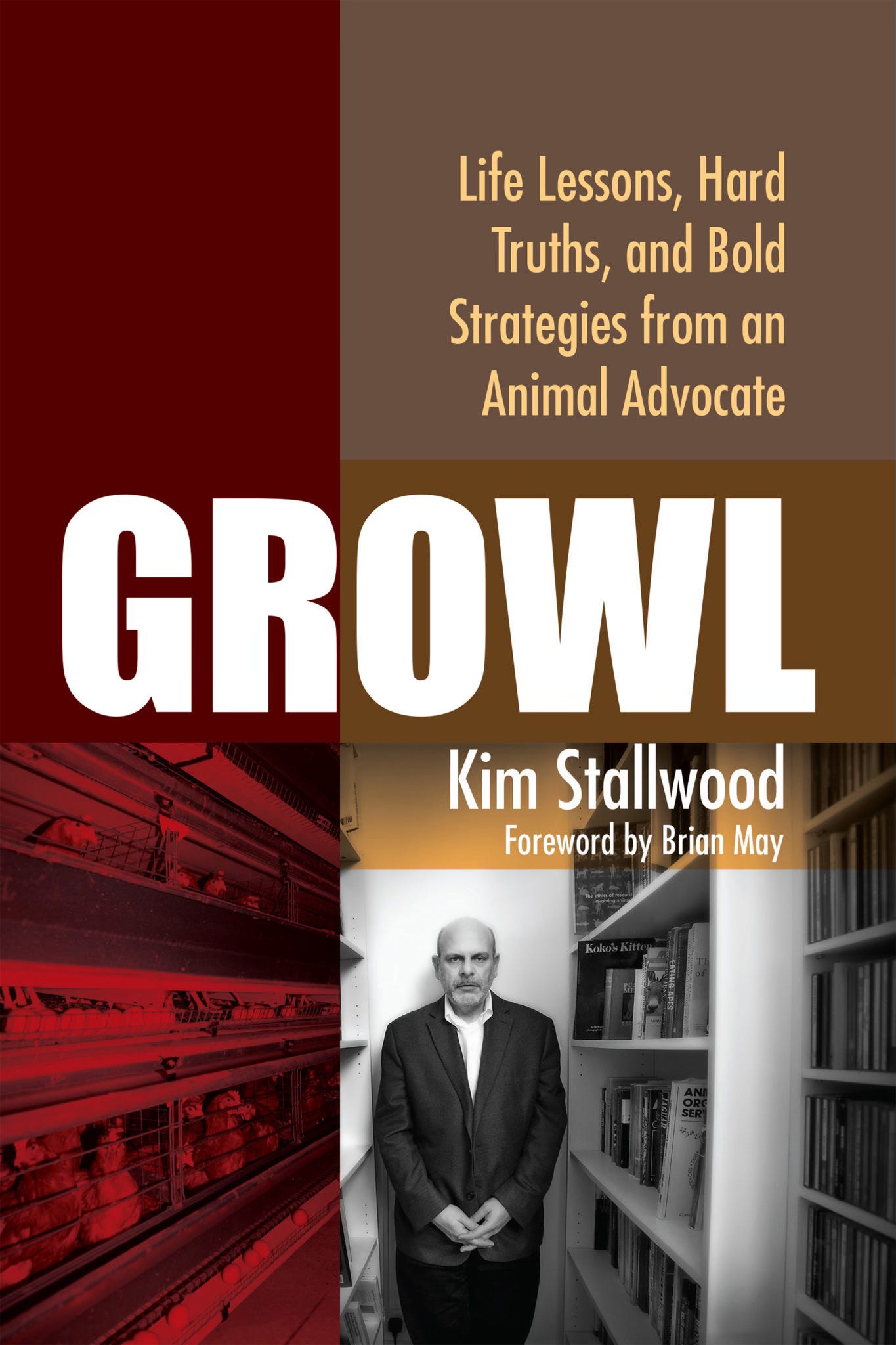
Adapted from Growl: Life Lessons, Hard Truths, and Bold Strategies from an Animal Advocate, with a Foreword by Brian May, and published by Lantern Publishing and Media in 2014. The Four Key Values in Animal Rights are Truth, Compassion, Nonviolence, and Justice. This is the second in a four-part series.
References
Fudge, Erica. 2008. Pets. Acumen.
Jones, Ken. 2003. The New Social Face of Buddhism. Wisdom.